Exciting opportunities
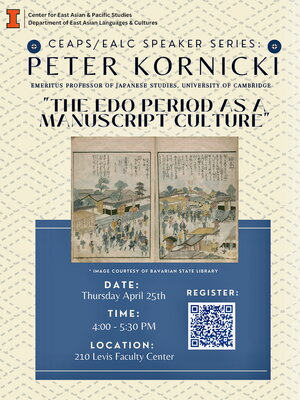
Event Spotlight: Lecture by renowned scholar Peter Kornicki
Printing began in Japan in the 8th century with the production of the Hyakumantō darani, though they were produced for ritual purposes not for reading. Texts were printed for reading from the 11th century onwards and from the beginning of the 17th century commercial publication took off rapidly and so successfully that by the 1660s catalogues of books in print were printed. So surely it is perverse to describe the Edo period as a manuscript culture? Well, no. Because the focus on Japan as a print society like that of contemporary Europe has blinded us to the dominance of manuscript culture...
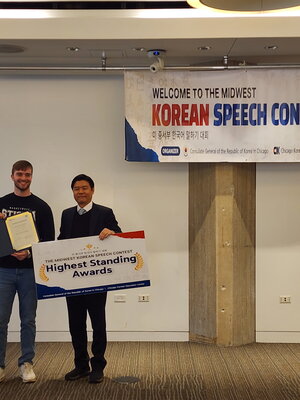
Student Spotlight: UIUC Cameron Roberts wins highest standing award in the 5th Midwest Korean Speech Contest
Cameron (Cam) Roberts, the winner of the Beginning Level at the 8th UIUC Korean Speech Contest, won the Highest Standing Award of the Beginning Level at the 5th Midwest Korean Speech Contest held on April 6, 2024. Cam will receive a scholarship to study at Sungkyunkwan University in Korea, in addition to an $800 cash airfare support award. Congratulations, Cam! Cam is receiving his award from Mr. Moon, Director of the Korean Education Center in Chicago, at the 5th Midwest Korean Speech Contest held on April 6, 2024.
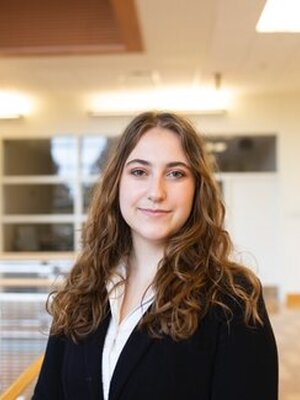
Student Spotlight: EALC Senior Grace Mitchell Named Schwarzman Scholar
Grace Mitchell, a senior double majoring in EALC and Political Science, was named a Schwarzman Scholar, one of 151 recipients selected from an international pool of 3,000 applicants. The program fully funds an annual Schwarzman class consisting of 40% U.S. students, 20% from China and Taiwan, and 40% from the rest of the world. Grace will be heading to Tsinghua University in Beijing for this fully-funded one-year master’s degree and leadership program. Congratulations, Grace!
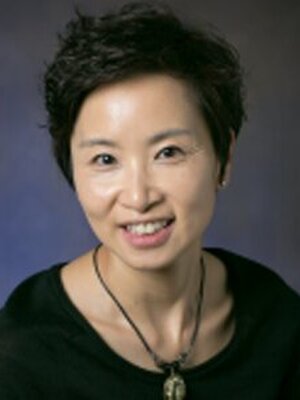
Faculty Spotlight: Jeeyoung Ha receives LAS Academic Professional Award
EALC faculty member and Director of Undegraduate Studies is one of the recipients of the the LAS Academic Professional Award. The recognition comes with a $1,000 award and a $1,000 salary increment supported by funds from LAS alumni. All six awardees will be honored at a ceremony in March. Read more here.

Faculty Spotlight: Myoung-Sun Song to join EALC faculty in Fall 2020
We are delighted to announce that Myoung-Sun Song will join the Department as Assistant Professor of Modern and Contemporary Korean Culture. Her research focuses on the intersections of race, gender, sexuality, class, and (national) identity in Korean media and popular culture. She is the author of Hanguk Hip Hop: Global Rap in South Korea (Palgrave Macmillan, 2019), the first scholarly book-length study on the subject. Before coming to Illinois, she taught at Sogang University in Seoul. Prof. Song will teach courses on contemporary Korean culture, society, and...
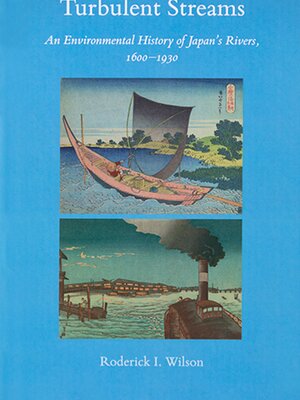
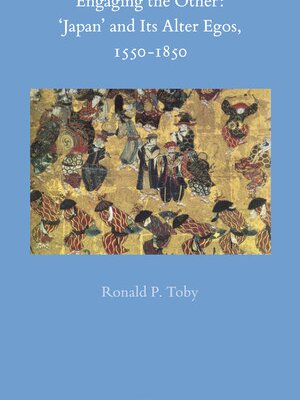
Publication Spotlight: New book by EALC Professor Emeritus Ronald Toby: Engaging the Other: 'Japan' and Its Alter-Egos, 1550-1850
In Engaging the Other: “Japan and Its Alter-Egos”, 1550-1850, Ronald P. Toby examines new discourses of identity and difference in early modern Japan, a discourse catalyzed by the “Iberian irruption,” the appearance of Portuguese and other new, radical others in the sixteenth century. The encounter with peoples and countries unimagined in earlier discourse provoked an identity crisis, a paradigm shift from a view of the world as comprising only “three countries” (sangoku), i.e., Japan, China and India, to a world of “myriad countries” ( bankoku) and...
EALC News
- Are you planning to study abroad in Korea next year or just want to learn a new language and culture of the Squid Game, BTS, and K-BBQ? SU24 KOR 201 will be a great opportunity to learn about the Korean culture and the basics of how to speak, read and write in... Read full story Summer 2024 Online KOR 201 [Elementary Korean 1]
- JAPN 201: Elementary Japanese I Introduction to Japanese, spoken language skills and the reading and writing of hirigana, katakana, and kanji. The course will be taught online using Zoom and Canvas. The class will meet synchronously for 2 hours, twice a week (typically... Read full story 2024 Summer Online JAPN 201
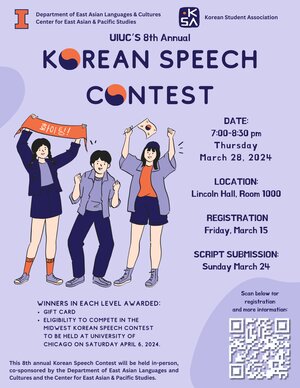
- The Eighth Annual UIUC Korean Speech Contest will be held in person at 7 pm in Lincoln Hall Room 1000 on Thursday, March 28, 2024. The event is co-sponsored by the Department of East Asian Languages and Cultures [EALC], the... Read full story The Eighth UIUC Korean Speech Contest at 7 pm on Thursday March 28, 2024
Title
Why Study EALC?
A degree from the Department of East Asian Languages & Cultures equips you with the knowledge and skills for a successful career in a variety of fields while nourishing your interest in different languages and cultures.